

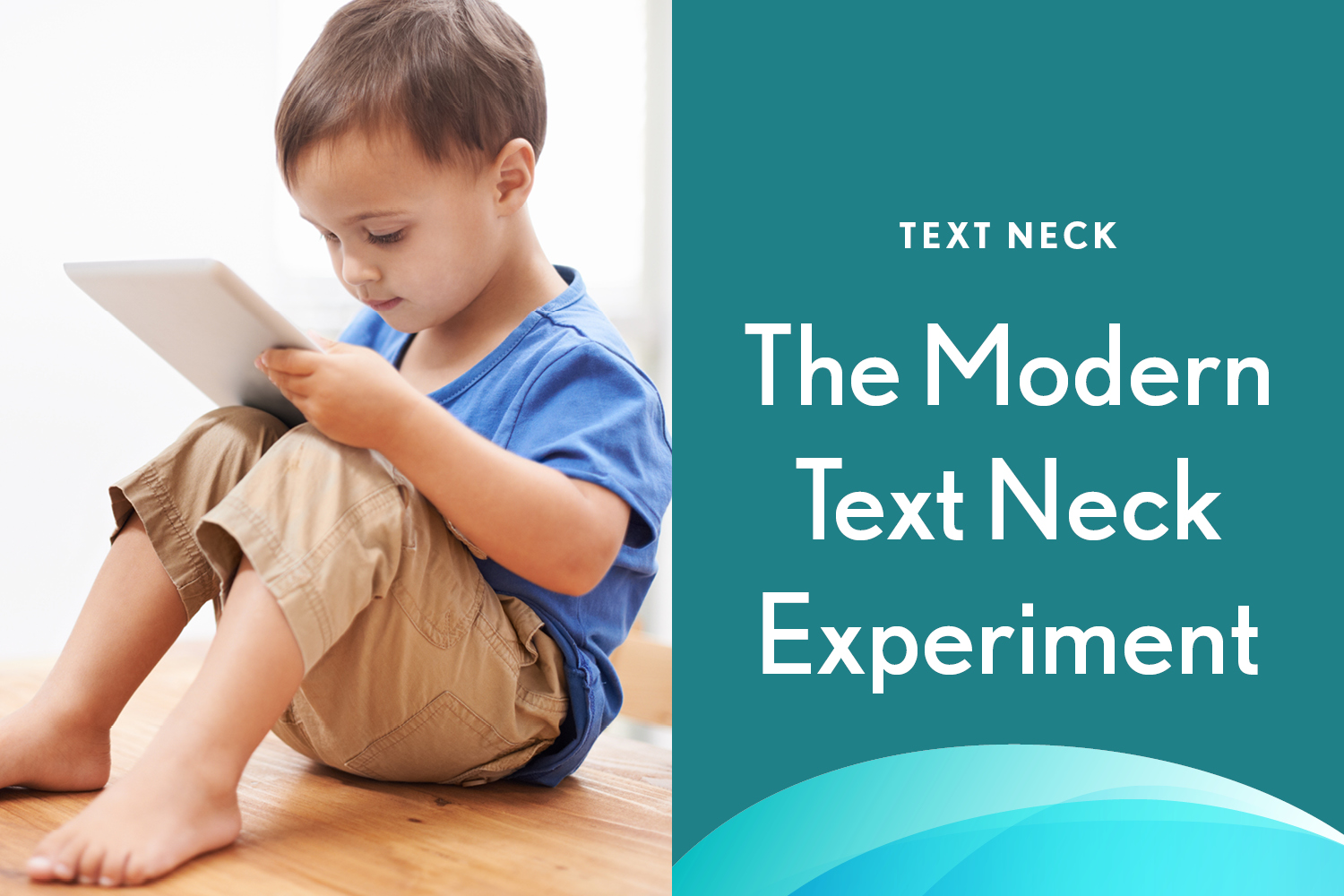
Watch a child on a tablet, and you’ll notice the head goes first. The chin drops, the shoulders follow, and they’ll sit like that for the best part of an hour.
Adults do it too, of course. At least they’re doing it with a spine that has finished growing, though. A child’s hasn’t, which makes it a rather different proposition.
What interests us as chiropractors is load. The angle of the head, the strain that angle creates, and the hours a day those joints are asked to hold it.
Load starts with weight, and an average adult head weighs about as much as a bowling ball. Stacked centrally over the shoulders, the spine carries it without complaint.
Tip it forward to read a notification, however, and the physics change.
Think about a heavy shopping bag. Held close to your side, you barely notice it. Held out at arm’s length, though, your shoulder gives up within seconds. Same bag, same weight, entirely different job.
In the same way, the further forward a head hangs, the harder the neck works to hold it. Repeated over months, that’s a considerable amount of extra load on a spine that hasn’t finished growing.
This forward-tipped posture is what people mean when they talk about “text neck”. It’s not a diagnosis, but the mechanical strain created when the head sits in front of the shoulders for long stretches.
That strain doesn’t stay in the neck, though. The slouch behind it has much wider effects.
When the chest rounds forward and the ribcage drops, there’s less room for the lungs to expand. As a result, taking a full breath in that position is harder work than it needs to be.
Comfortable breathing is worth more than it sounds. Upright posture has been linked with steadier mood and better resilience under pressure.
None of this is an argument for getting rid of devices. It’s an argument about where they sit.
One rule covers most of it. Bring the screen up to your eyes rather than dropping your chin down to the screen. In practice that might mean a tablet propped on a cushion, or a phone held a little higher.
Lying on their front to read or watch something is worth encouraging too. It asks a child to lift their head and draw the shoulders back, which is roughly the opposite of the school-day slouch.
That slouch is worth countering early, because a posture repeated often enough stops feeling like a choice. The muscles at the front shorten, the joints of the mid-back stiffen, and as a result standing tall starts to feel like effort rather than rest.
That’s usually the point where the mid-back stops pulling its weight and the neck ends up covering for it. Gentle chiropractic adjustments work on the joints that have gone quiet, which may help the load spread more evenly across the spine again.
Worth saying that a slouch isn’t damage. It’s a pattern, and patterns respond to being interrupted.
The interruptions that work are the ones nobody has to remember. Nobody sticks to a rule that needs constant policing, so the ones that last are built into how a room works.
A cushion left where the tablet usually lands, for instance, or a charging point that isn’t beside the bed. Homework at a table rather than on the floor.
These aren’t big interventions. They’re small shifts in where a device naturally ends up, and they change the posture a child drops into without thinking. Over time, that changes what one growing spine is asked to carry, which is the part within reach.
